
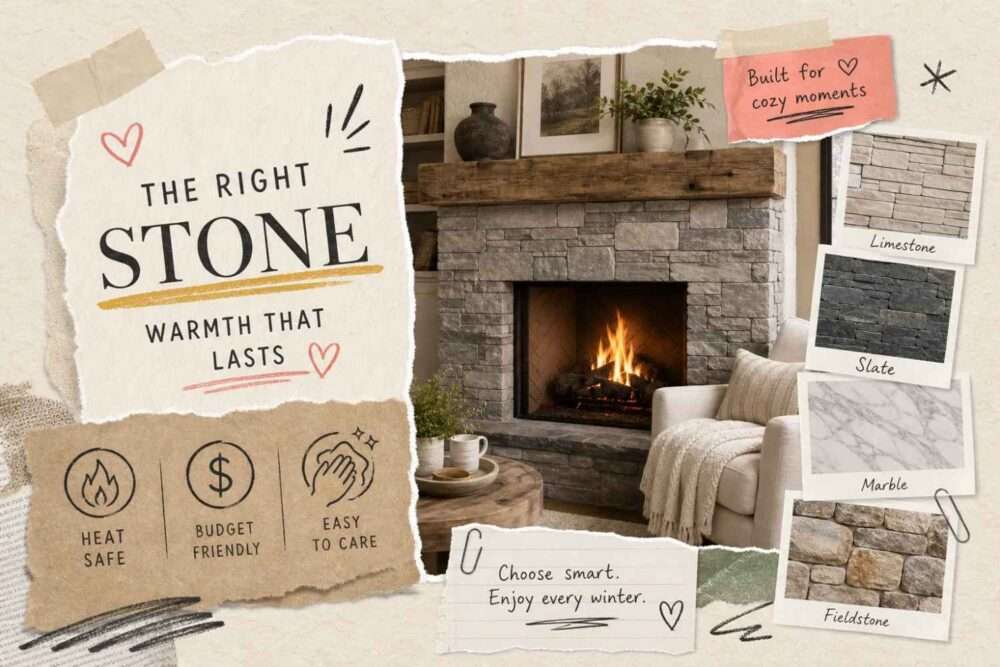
What is the best stone for a fireplace surround? It’s a question worth answering carefully before you buy. A beautiful fireplace surround is often a focal point in a living room, and some homeowners pick a stone based on how it looks in a photo, then discover too late that it chips at the edges, traps soot in its pores, or develops hairline cracks after the first heating season. The material choice matters far more than most people realize.
Not all stones handle sustained radiant heat, thermal cycling, and everyday dust exposure the same way. This guide compares the most common fireplace stone types, granite, quartzite, limestone, slate, travertine, and manufactured stone veneer, across four practical filters: heat resistance, durability, cost, and maintenance. By the end, you’ll know which stone fits your home, your budget, and your actual maintenance tolerance. Stone looks fundamentally different in person than it does on a screen, and that difference matters most when you’re choosing a material for the most prominent wall in your living room.
TL;DR – Best Stone for a Fireplace Surround
- Safest long-term choices: Granite and quartzite (best heat resistance + durability for wood or gas fireplaces)
- Best budget / retrofit option: Manufactured stone veneer
- Traditional look (with more maintenance): Limestone or travertine — better for gas fireplaces only
- Rustic / industrial look: Slate (use thicker, higher-grade material)
- Key rule: Match the stone to your heat source and how much upkeep you’re willing to do. Always see samples in person.
What Is the Best Stone for a Fireplace Surround? Start Here.
Before diving into individual materials, here’s a quick-reference summary to orient your decision:
- Best for heat resistance and durability: Granite, quartzite
- Best for budget projects or retrofits: Manufactured stone veneer
- Best for traditional style (with tradeoffs): Limestone, travertine (gas fireplaces only)
- Best for rustic or industrial looks: Slate
If you want the short answer: granite and quartzite are the safest long-term choices for most fireplace applications, wood-burning or gas. Everything below explains why, and where the other options fit.

What Actually Makes a Stone Safe Around a Fireplace
Heat Resistance Is Not the Same as Fire Resistance
Every natural stone is non-combustible, but that doesn’t mean every stone handles heat equally well. The Mohs hardness scale is a useful proxy: harder, denser stones like granite (6–7) and quartzite (~7) resist thermal stress far better than softer sedimentary stones like limestone and travertine (both around 3–4).
Thermal performance depends on more than density alone. Thermal conductivity, specific heat capacity, and thermal expansion coefficients all affect how a stone responds to heat cycling and how prone it is to fracture under thermal shock.
The most common cause of cracking near a fireplace opening isn’t steady heat; it’s thermal shock from sudden temperature swings. A stone that sits cold all week and then gets blasted with intense heat from a wood fire is at greater risk than one near a gas fireplace that cycles on and off gradually. Understanding that distinction helps you match the stone to your heating source, not just to your design aesthetic.
Building Code Clearances Every Homeowner Should Know
The International Residential Code clearance rules for combustible materials, including wood trim and mantels, requires at least 6 inches distance from a fireplace opening. If combustible material falls within 12 inches of the opening, it cannot project more than 1/8 inch per inch of distance from that opening. In plain terms: the closer the wood trim is to the firebox, the flatter it must sit against the wall. These clearances apply to the framing and trim, not to the stone itself.
Natural stone, brick, and similar non-combustible masonry finishes are generally acceptable directly adjacent to the firebox. The real risk comes from combustible backing materials, adhesives, or framing elements inside the clearance zone. Always confirm clearance requirements with a licensed contractor before finalizing your surround design, especially if you’re working with a wood-burning unit.
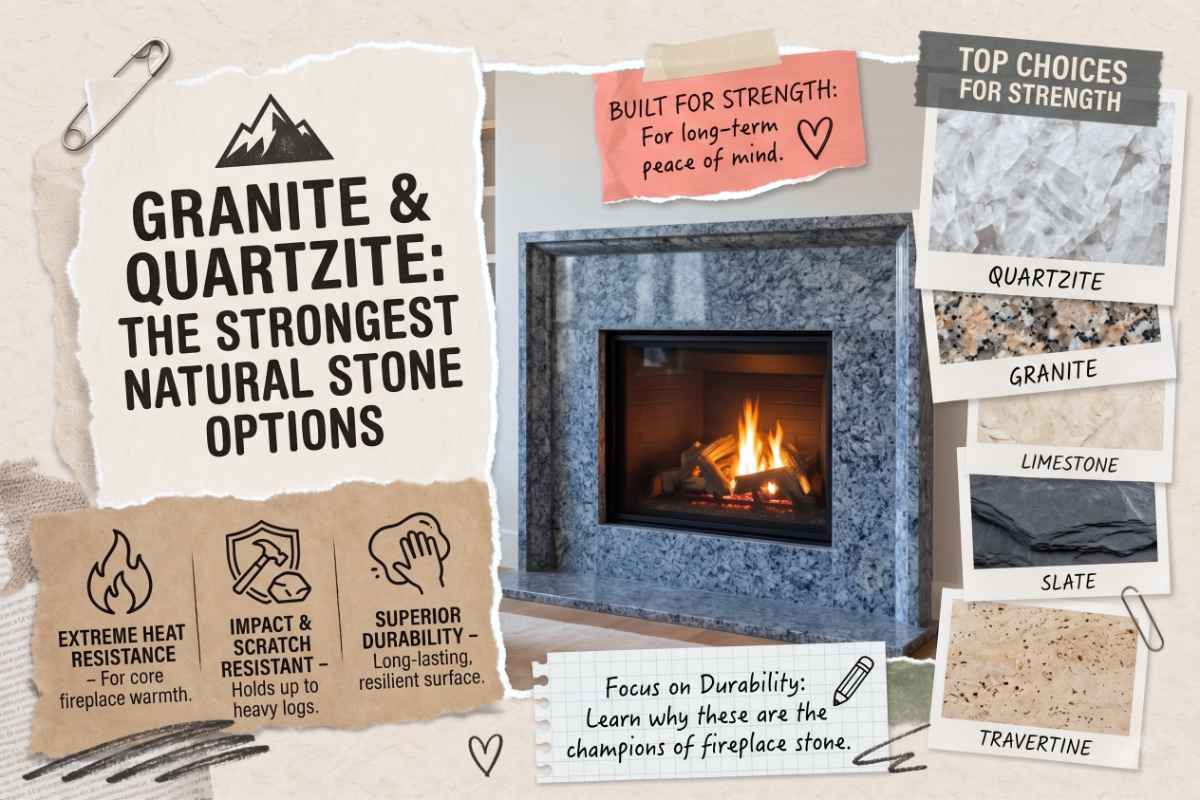
Granite and Quartzite: The Strongest Natural Stone Options
Why Granite Is One of the Safest Choices for a Natural Stone Fireplace Facing
Granite’s combination of low-to-moderate porosity and a Mohs hardness of 6–7 makes it one of the most reliable answers to what is the best stone for a fireplace surround. It tolerates sustained radiant heat well—some materials-science and trade sources cite heat tolerance up to approximately 1,200°F under non-shock conditions, though actual performance varies by specific stone composition. For a standard wood-burning or gas fireplace, that margin gives you plenty of buffer for normal use.
Granite also offers one of the widest aesthetic ranges of any natural stone, from subtle speckled neutrals to dramatic veining in blacks, blues, and earth tones. Material costs typically run $40–$90 per square foot, with installed costs in the $60–$75 per square foot range. In mid-Missouri, regional labor rates commonly run below coastal metro averages, which helps keep total project costs reasonable.
Quartzite: A Heat-Resistant Fireplace Material Worth Considering
Quartzite sits at roughly Mohs 7, making it slightly harder than granite and equally heat-resistant. Its lower porosity compared with marble, limestone, and travertine makes it more stain-resistant and easier to maintain in an environment where soot and dust are constant factors. One important clarification: quartzite is not the same as engineered quartz. Engineered quartz contains resins that degrade under high heat; true natural quartzite does not have that limitation.
Quartzite pricing is comparable to or slightly above granite, depending on slab availability in your area. If long-term durability is your top priority and you want a stone that resists both heat and edge chipping over years of use, quartzite is the stronger all-around performer of the two.
| Stone Type | Heat Resistance | Durability | Material Cost (per sq. ft.) | Maintenance Level | Best For |
|---|---|---|---|---|---|
| Granite | Excellent | Excellent (Mohs 6–7) | $40–$90 | Low–Moderate (seal every 1–2 yrs) | Wood or gas fireplaces |
| Quartzite | Excellent | Excellent (Mohs ~7) | Comparable to granite | Low (excellent stain resistance) | Long-term durability priority |
| Slate | Very Good | Good–Very Good (Mohs 5–6) | $25–$40 | Moderate | Rustic or industrial looks |
| Limestone | Fair–Good | Fair (Mohs 3–4) | Mid-range | Higher (seal every 6–12 months) | Traditional / gas fireplaces only |
| Travertine | Fair | Fair (most porous) | Mid-range | Highest | Gas fireplaces, warm aesthetics |
| Manufactured Stone Veneer | Good | Good (installation-dependent) | $6–$9 | Low–Moderate | Budget projects & retrofits |
Limestone, Slate, and Travertine: Style-Forward Options With Tradeoffs
Limestone’s Appeal and Its Vulnerability Near Heat
Limestone’s warm, matte finish works beautifully in traditional, farmhouse, and Mediterranean-style homes. The softer character (Mohs 3–4) gives it a natural, hand-hewn quality that harder stones can’t replicate. That same softness is also where the problems start near a fireplace.
Limestone is more porous than granite or quartzite, more prone to spalling and chipping at edges, and highly vulnerable to etching from acidic cleaners. Near a fireplace, the combination of heat cycling, dust, and occasional moisture makes sealing and maintenance more demanding. You can make it work, but go in with realistic expectations about the upkeep involved.
Slate’s Layered Look and What to Know About Cracking
Slate lands in the Mohs 5–6 range and brings a distinctive cleft texture and a rich color palette: charcoal, rust, deep green-gray. It handles household heat reasonably well and works as a fireplace facing material when properly installed. The failure mode to understand is layer separation along natural cleavage planes, not random fracture like softer stones.
Thin or lower-grade slate is the real risk; it can delaminate over time under thermal stress or impact. Stick with thicker, higher-grade material and confirm your installer has experience with cleft-face stone. Installed costs typically run around $70 per square foot, with material in the $25–$40 range.
Travertine: Beautiful but the Most Porous of the Group
Travertine shares limestone’s Mohs rating of 3–4 and has one additional complication: natural voids and pits throughout the stone. If those voids are unfilled or poorly sealed, they trap soot, moisture, and heat-related debris directly around the firebox, making the surface harder to clean with every passing season.
Travertine’s warm ivory and beige tones are genuinely striking, and it photographs beautifully. It also carries the highest maintenance commitment of any stone covered in this guide. Given its porosity and the difficulty of removing soot from an unfilled surface, travertine is often a better match for gas fireplaces, where heat output and soot exposure are significantly lower than with wood-burning units.

Manufactured Stone Veneer: Lighter, Cheaper, and Easier to Install
The Installation Advantages That Make Veneer Worth Considering
Manufactured stone veneer, a cement-based composite, typically weighs 8–12 lbs per square foot. Full-thickness natural stone comes in at 40–73 lbs per square foot; even thin natural veneer runs about 13 lbs. That weight difference eliminates the need for a structural footing or reinforced substrate in most applications, which keeps labor costs lower and makes retrofit installations on existing fireplaces practical.
Material cost runs roughly $6–$9 per square foot. Complete installed projects typically land in the $1,880–$2,630 range. Compare that with $8,000–$20,000 for full natural stone fireplace installations. For homeowners working with a tighter budget or updating an existing surround without a major rebuild, manufactured veneer is a legitimate option.
For practical help choosing the right product, explore our selection of natural thin stone veneer designed for fireplaces and chimneys.
Where Manufactured Veneer Falls Short of Natural Stone
Visual authenticity is the main tradeoff. Veneer products have improved substantially, but repeating patterns in some product lines are visible up close in a way natural stone simply isn’t. On a fireplace surround that sits front and center in a main living space, that distinction matters more than it would on an exterior retaining wall.
Cracking risk in veneer is more installation-dependent than material-dependent. Substrate movement, thermal expansion mismatch, or improper mortar application are the most common failure causes. Hire an installer who has worked specifically with veneer on fireplace surrounds, and confirm they’re following the manufacturer’s substrate prep requirements.
What Fireplace Surround Stone Actually Costs in 2026
Material and Installed Cost by Stone Type
Here’s a practical breakdown of current U.S. cost ranges for the most common fireplace surround materials:
- Granite: $40–$90/sq. ft. material; $60–$75/sq. ft. installed
- Marble: $60–$200/sq. ft. material; installed costs vary widely by project scope
- Slate: $25–$40/sq. ft. material; approximately $70/sq. ft. installed
- Limestone/travertine: $40–$75/sq. ft. installed; full surround projects can reach $8,000–$20,000
- Manufactured stone veneer: $6–$9/sq. ft. material; $1,880–$2,630 per project installed
These are U.S. averages. Regional labor rates in the inland Midwest commonly run below coastal metro averages, so your total installed cost will often come in below the high end of these ranges.
What Drives Costs Up Beyond the Stone Itself
Full-thickness natural stone requires more structural prep and heavier labor than thin-cut stone veneer. Custom cuts, intricate profiles, and hearth extensions all add to the final invoice before a single piece of stone goes on the wall. Factor in the cost of sealer, mortar, and any substrate repair when comparing quotes side by side.
A realistic planning number for a natural stone fireplace facing in mid-Missouri, materials and installation combined, falls in the $55–$140 per square foot range, with most projects landing around $85–$90 per square foot. Get at least two itemized quotes from contractors who specialize in masonry and hardscape work, not general remodelers.

Maintenance, Sealing, and Seeing Your Options in Person
Sealing and Cleaning Routines by Stone Type
Granite and quartzite need a penetrating impregnating sealer reapplied every 1–2 years, though frequency can vary depending on porosity and how heavily the fireplace is used. Use a pH-neutral stone cleaner for routine care, and blot spills immediately rather than wiping them across the surface. For oil or rust stains, treat with a poultice rather than scrubbing.
Limestone and travertine require sealing every 6–12 months given their higher porosity. Avoid any acidic cleaner entirely; even mild household products can etch the surface. Slate benefits from a penetrating sealer as well, with regular attention to keeping its textured cleft surface free of soot buildup. For manufactured veneer, follow the manufacturer’s specific care instructions and avoid pressure washing near mortar joints on interior installations.
Why Seeing Stone in Person Before You Buy Matters
Stone looks different on a screen than it does in your hands. Undertones shift under different light sources, textures read differently at scale, and the weight and finish of a material tell you things a product photo never will. Viewing samples side by side, in both natural and interior light, is the single fastest way to narrow down your options and avoid a costly mistake.
Southwest Stone Supply of Osage Beach stocks a wide range of real natural stone veneer and fireplace-ready stone in mid-Missouri’s Lake of the Ozarks region. The team can walk you through options suited to your home’s style and to Missouri’s climate demands, including how specific stones perform through freeze-thaw cycles if your surround extends to an outdoor fireplace or fire feature. That regional, hands-on knowledge is hard to replicate when ordering off a website or browsing a big-box store with three stone options on display.
Common Questions About Fireplace Surround Stone
1. What is the best stone for a fireplace surround?
Granite and quartzite are the safest long-term choices for most wood-burning or gas fireplaces because of their superior heat resistance and durability.
2. Can I use limestone or travertine around a fireplace?
Yes, but they are better suited to gas fireplaces. Both are softer and more porous, so they need more frequent sealing and careful maintenance, especially with wood-burning units.
3. Is manufactured stone veneer safe for a fireplace surround?
Yes. Manufactured stone veneer is non-combustible and commonly used. It’s lighter, more affordable, and easier to install than full natural stone, though it may not have the same authentic look up close.
4. How much does a stone fireplace surround cost?
In mid-Missouri, expect roughly $55–$140 per square foot installed for natural stone (most projects land around $85–$90). Manufactured veneer projects often fall in the $1,880–$2,630 range.
5. Do I need to seal natural stone around a fireplace?
Yes. Granite and quartzite typically need a penetrating sealer every 1–2 years. Limestone and travertine need sealing every 6–12 months because they are more porous.
6. What is the difference between quartzite and engineered quartz for fireplaces?
True natural quartzite handles high heat well. Engineered quartz contains resins that can degrade under sustained heat and is not recommended for fireplace surrounds.
7. Should I see stone samples in person before buying?
Absolutely. Color, texture, and undertones look different in real lighting than they do on a screen. Seeing and handling samples is the fastest way to avoid an expensive mismatch.
What Is the Best Stone for a Fireplace Surround? The Bottom Line
Start with heat resistance and building code clearances, then narrow by durability. Granite and quartzite are the safest long-term choices for most fireplace applications, wood-burning or gas. From there, weigh budget against the maintenance commitment each stone demands, and be honest about how much upkeep you’ll actually do consistently.
Manufactured stone veneer is a legitimate choice for budget-conscious projects or retrofit applications where adding structural support isn’t practical. Natural stone offers authenticity and longevity that holds its value over time. The right answer to what is the best stone for a fireplace surround depends on your heating source, your style preferences, and your maintenance tolerance—and it’s one you arrive at with real samples in hand, not just a browser tab.
Stop by our 6-acre yard + indoor showroom at Southwest Stone Supply. Handle the materials, and talk through your project with someone with expert local advice who works with stone every day—it usually resolves the decision faster than another hour of online research. After all, we’ve been doing stone right for 20+ years (since 2001).
Ready to find the best stone for your fireplace surround project?
Call our Lake of the Ozarks area team at (573) 302-8855 or visit us at 6386 Osage Beach Pkwy, Osage Beach, MO, for expert advice, current pricing, and fast delivery. We ship nationwide, and we’ll help make your fireplace the envy of the neighborhood!
Want to see more landscape & home improvement tips? You may find these posts helpful!
Bulk Landscape Rock That Actually Holds Up in Missouri Weather
Overview: Buying bulk landscape rock saves money and time compared to bagged material when you’re covering beds, creating drainage areas, building pathways,

Gravel Calculator for Missouri Landscaping – Real Examples from the Lake of the Ozarks
Do you need to figure out exactly how much gravel you need for a patio, driveway, French drain, or shoreline project around

Easiest Low-Maintenance Landscaping for Missouri Homes
TL;DR Missouri’s freeze-thaw winters and hot, humid summers destroy traditional mulch and grass landscapes. The easiest low-maintenance landscaping solution is stone ground